
上海金畔生物科技有限公司代理New England Biolabs(NEB)酶试剂全线产品,欢迎访问官网了解更多产品信息和订购。
产品信息
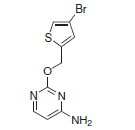
CLIP-tag 蛋白标记系统能将目标蛋白以共价结合的形式,特异性地标记上任何分子。CLIP-tag 是一种基于人 O6-烷基鸟嘌呤-DNA-烷基转移酶(O6-alkylguanine-DNA-alkyltransferase,hAGT)的蛋白。CLIP-tag 的底物是苄基胞嘧啶(benzylcytosine,BC)的衍生物。在标记反应中,底物的苄基部分被替换,与 CLIP-tag 的活性半胱氨酸共价结合,形成稳定的硫醚键。尽管 CLIP-tag 与 SNAP-tag® 基于相同的蛋白,苄基胞嘧啶底物是一类独立的底物,和 SNAP-tag 所识别的苄基鸟嘌呤底物不同。CLIP-tag 和 SNAP-tag 可同时用于同一细胞中两种蛋白的正交和互补标记。
该体系包括两个步骤:亚克隆并表达与 CLIP-tag 融合的目的蛋白;选择 CLIP-tag 底物进行标记融合蛋白。有关利用 CLIP-Cell 底物在标记融合蛋白时使用 BTC 的信息,请参阅本文说明。
- 产品类别:
- Discontinued (<3 years)
-
特性和用法
需要但不提供的材料
- 表达 CLIP-tag 融合蛋白的细胞
- 组织培养材料和培养基
- 转染试剂
- 荧光显微镜及适用的滤光装置
- DMSO
-
注意事项
- 贮存条件:CLIP-Cell 阻断剂应贮存于 -20℃(长期贮存)或 4℃(短期贮存)。如果 CLIP-Cell 阻断剂妥善贮存于 -20℃,干燥贮存的阻断剂至少可以保持稳定三年,溶解在 DMSO 中时至少可保持稳定三个月。
- 如需问题解决指南,请参阅 CLIP-Cell 产品随附的说明书。
- 请注意,细胞中的蛋白会不断更替和再合成。在阻断细胞内所有现有的 CLIP-tag 融合蛋白后,新的 CLIP-tag 融合蛋白分子可能会在此期间合成,并在与荧光 CLIP-tag 底物一起温育时被标记。这会给人一种阻断剂无效的错觉。为了最大限度地减少对蛋白合成和蛋白运输的影响,可使用放线菌酮处理细胞,并且在 4℃ 温育细胞与荧光 CLIP-tag 底物。
操作说明、说明书 & 用法
-
操作说明
- Use with CLIP-tag substrates (S9220)
- Labeling of Proteins in vitro (S9220)
工具 & 资源
-
选择指南
- Comparison of SNAP-tag®/CLIP-tag™ Technologies to GFP
FAQs & 问题解决指南
-
FAQs
- What is the SNAP-tag®?
- How does it work?
- How specific is the binding of substrate to the SNAP-tag®?
- How does SNAP-tag labeling differ from using GFP fusion proteins?
- What linker type and length would you recommend?
- Can I clone my protein as a fusion to the N- or C-terminus of the tags?
- What is the smallest peptide and biggest protein you have cloned as SNAP-tag fusions?
- What is the solubility of SNAP-tag in insect and bacterial expression systems?
- What competent cell strains does NEB suggest for expression in E. coli?
- What competent cell E. coli strains are suitable for propagating SNAP-tag plasmids?
- Can SNAP-tag fusions be purified and refolded from inclusion bodies?
- Are substrates toxic to cells?
- Can cells expressing SNAP-tag be fixed prior to labeling?
- Can SNAP-tag be multiplexed with other protein labeling systems (GFP, Antibody)?
- Can you use SNAP-tag for in vivo FRET?
- Can cell-impermeable substrates be microinjected into cells, and how is the excess substrate exported?
- Does the SNAP-tag labeling reaction work in yeast?
- What happens to the fluorophore upon proteolysis?
- What conditions are recommended for SNAP-tag labeling in vitro?
- What conditions are incompatible with SNAP-tag labeling in vitro?
- Can SNAP-tag fusion proteins be labeled in a cell lysate?
- I have a compound that I would like to couple to a BG derivative. Where can I get advice?
- What is the difference between SNAP-tag and ACP-tag?
- Cellular Imaging and Analysis FAQs
-
问题解决指南
- Labeling with SNAP-tag® Technology Troubleshooting Guide
-
实验技巧
添加 DMSO 后,使用移液枪吸打混匀至少 10-20 次,然后剧烈涡旋至少 1 分钟,以确保底物完全溶解。
在完全培养基中稀释底物后,使用移液枪吸打混匀至少 10 次,有助于降低背景。
增加底物浓度和/或反应时间通常会导致背景较高,并且不一定会增加信噪比(SNR)。